Our paper "Detecting Insufficient Access Control in Web Applications" was accepted for the First SysSec Workshop.
This work is a follow-up research based on the OWASP Access Control Rules Tester project, which was initiated during the OWASP Summer of Code 2008.
If any of you guys happen to attend DIMVA'11 at Amsterdam, I'd be very glad to meet for a beer :)
Acknowledgements. I'd like to thank George Noseevich, who have put so much effort into this project and this paper.
четверг, 2 июня 2011 г.

суббота, 9 апреля 2011 г.
Comments on the talk made by Rafal Los (HP) about business logic flaws at Blackhat
Recently I've stumbled upon a talk on business logic vulnerabilites (whitepaper available here) made by Rafal Los at BlackHat Europe. Being a guy personally interested in the topic I decided to share my thoughts (rather critical) on the subject. I have divided my thoughts into two categories.
Inaccuracy in wordings and definitions.
1. The definition of business logic flaw is too general to be useful.
"A defect that exposes the component business processes or component flows to manipulation from the attacker perspective to achieve unintended and undesirable consequences from the design perspective; without disrupting the general function or continuity of the application."
Well, almost every application uses a so-called internal state to carry out its operations. In general, every web application workflow is a sequence of computational steps. Each computational step can be guarded by a predicate on the internal state. Hence, modification of internal state can alter a web application workflow by enabling other computational steps or disabling particular ones within it. Thus, every flaw in web application, which could be used to alter the internal state of web application may lead to attacks satisfying the definition presented by Rafal. SQL injection is the best example here.
2. 'Taxonomy' is a wrong word.
The confusion starts from the point where Rafal has introduced the term "taxonomy". Talking about taxonomies is dangerous. One have to prove the properties of the proposed taxonomy or at least try to. Rafal introduces a taxonomy of business logic flaws which consists of two classes. Neither criteria which were used to create those classes, nor a classification procedure were provided.
After all, Rafal is mixing several terms: a vulnerability (which is an enabling property of a software for a successful attack), an attack (one of the possible manifestations of an exploitable flaw) and a goal of an attack (what an attacker wishes to achieve). The same goal could be achieved through different vulns; a single vuln could be exploited for different goals. Rafal ties the first class of business logic flaws to "privilege manipulation", which is a goal. IMO this is wrong approach - this goal could be achieved through different attacks (and underlying vulns): SQLi (login bypass through injection), forceful browsing or even server misconfiguration. How does these relate to business logic?
The same applies to the second class, which is "Transaction Control Manipulation".
Finally, OWASP Top 10 is not a taxonomy and never meant to be. It is just an ordered list.
Doubts related to the proposed ideas
A method intended to find business logic flaws should operate in terms of the business domain and application logic. Hence, the first problem, which should be solved, is mapping of a set of possible interactions with web applications into use cases (which would be the basis for further analysis). It is not possible to automate this step without specification (not to mention technical issues like form submissions & captchas).
Ok, let's suppose we have solved the first problem. Now the second question is: how does the proposed approach differ from the known Q&A methods like fault injection, tests mutations, etc? Could you point out the added value of the proposed approach?
Final words
And in the end I'd like to point out the previous researches in the area, which Rafal hadn't mentioned in his white-paper:
- Differential analysis and its variants. This technique was described in several sources [1], [2], [3] and was designed for finding improper access control implementations. This means that from the methodological point of view the problem of detecting improper access control is already solved. Btw, some of these ideas were implemented in IBM AppScan, AFAIK.
- "Toward Automated Detection of Logic Vulnerabilities in Web Applications". A good example of how business logic flaws could be formalized. Not a black-box approach though.
- "Multi-Module Vulnerability Analysis of Web-based Applications". An example of how a notion of "intended workflow" could be formalized. Not a black-box approach though.
References
[1] J. Scambray and M. Shema, Hacking exposed: Web applications. McGraw-Hill Osborne Media, 2002.
[2] O. Segal, “Automated testing of privilege escalation in web applications,” Watchfire, 2006.
[3] D. Stuttard and M. Pinto, The Web Application Hacker’s Handbook: Discovering and Exploiting Security Flaws. Wiley Publishsing, 2007.
Inaccuracy in wordings and definitions.
1. The definition of business logic flaw is too general to be useful.
"A defect that exposes the component business processes or component flows to manipulation from the attacker perspective to achieve unintended and undesirable consequences from the design perspective; without disrupting the general function or continuity of the application."
Well, almost every application uses a so-called internal state to carry out its operations. In general, every web application workflow is a sequence of computational steps. Each computational step can be guarded by a predicate on the internal state. Hence, modification of internal state can alter a web application workflow by enabling other computational steps or disabling particular ones within it. Thus, every flaw in web application, which could be used to alter the internal state of web application may lead to attacks satisfying the definition presented by Rafal. SQL injection is the best example here.
2. 'Taxonomy' is a wrong word.
The confusion starts from the point where Rafal has introduced the term "taxonomy". Talking about taxonomies is dangerous. One have to prove the properties of the proposed taxonomy or at least try to. Rafal introduces a taxonomy of business logic flaws which consists of two classes. Neither criteria which were used to create those classes, nor a classification procedure were provided.
After all, Rafal is mixing several terms: a vulnerability (which is an enabling property of a software for a successful attack), an attack (one of the possible manifestations of an exploitable flaw) and a goal of an attack (what an attacker wishes to achieve). The same goal could be achieved through different vulns; a single vuln could be exploited for different goals. Rafal ties the first class of business logic flaws to "privilege manipulation", which is a goal. IMO this is wrong approach - this goal could be achieved through different attacks (and underlying vulns): SQLi (login bypass through
The same applies to the second class, which is "Transaction Control Manipulation".
Finally, OWASP Top 10 is not a taxonomy and never meant to be. It is just an ordered list.
Doubts related to the proposed ideas
A method intended to find business logic flaws should operate in terms of the business domain and application logic. Hence, the first problem, which should be solved, is mapping of a set of possible interactions with web applications into use cases (which would be the basis for further analysis). It is not possible to automate this step without specification (not to mention technical issues like form submissions & captchas).
Ok, let's suppose we have solved the first problem. Now the second question is: how does the proposed approach differ from the known Q&A methods like fault injection, tests mutations, etc? Could you point out the added value of the proposed approach?
Final words
And in the end I'd like to point out the previous researches in the area, which Rafal hadn't mentioned in his white-paper:
- Differential analysis and its variants. This technique was described in several sources [1], [2], [3] and was designed for finding improper access control implementations. This means that from the methodological point of view the problem of detecting improper access control is already solved. Btw, some of these ideas were implemented in IBM AppScan, AFAIK.
- "Toward Automated Detection of Logic Vulnerabilities in Web Applications". A good example of how business logic flaws could be formalized. Not a black-box approach though.
- "Multi-Module Vulnerability Analysis of Web-based Applications". An example of how a notion of "intended workflow" could be formalized. Not a black-box approach though.
References
[1] J. Scambray and M. Shema, Hacking exposed: Web applications. McGraw-Hill Osborne Media, 2002.
[2] O. Segal, “Automated testing of privilege escalation in web applications,” Watchfire, 2006.
[3] D. Stuttard and M. Pinto, The Web Application Hacker’s Handbook: Discovering and Exploiting Security Flaws. Wiley Publishsing, 2007.
воскресенье, 27 февраля 2011 г.
ruCTF'2011 Quals
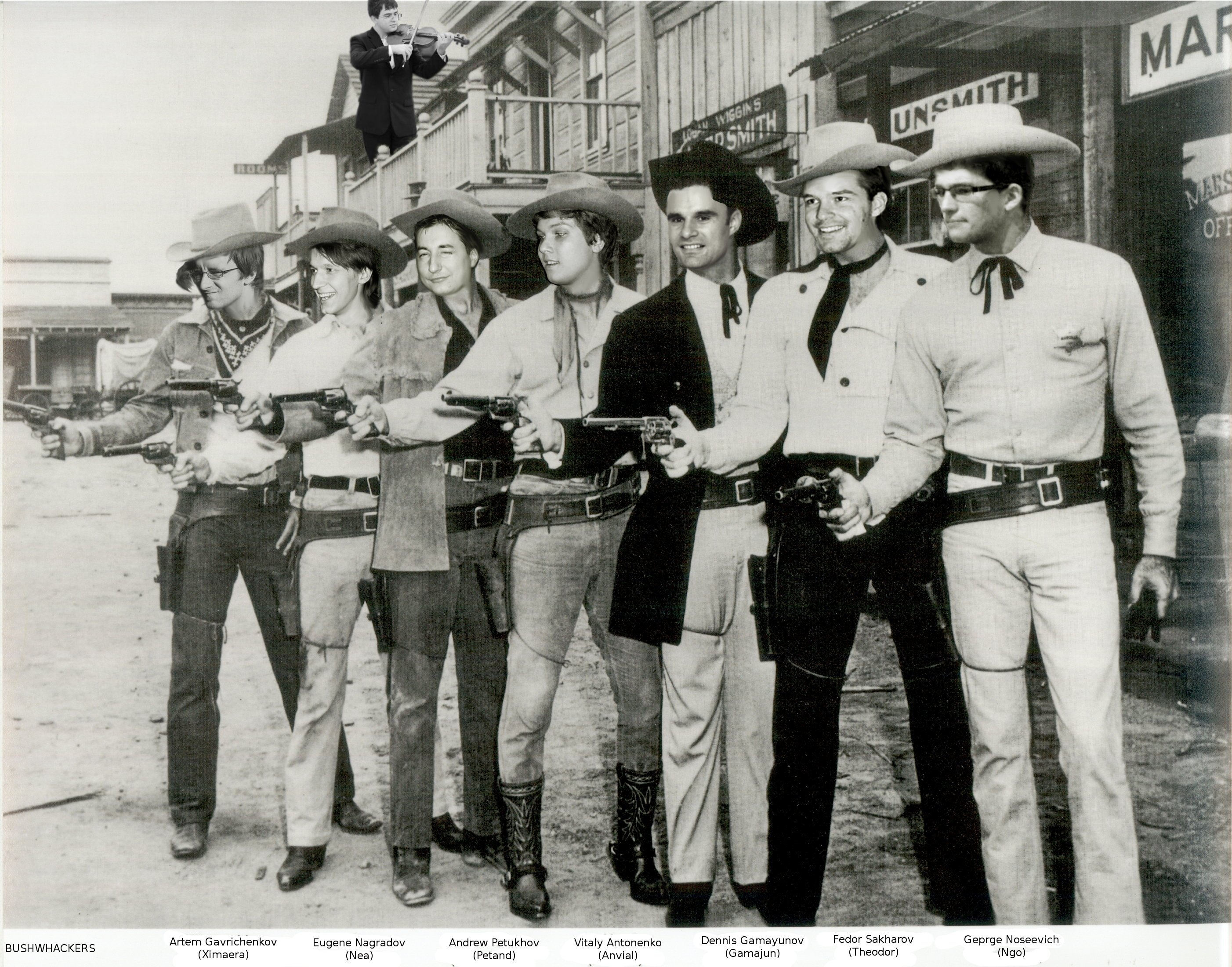
Well, our CTF team Bushwhackers took the first place in the ruCTF'2011 Qualification game. I'd like to congratulate all the team members with this victory. Wishing the same luck in the Final.
I'd also like to thank the organization team for their efforts.
Here's some evidences of our team at work:

I'd also like to thank the organization team for their efforts.
Here's some evidences of our team at work:
воскресенье, 23 января 2011 г.
Web application scanner comparison efforts
It's been three months since we started a project, which aims at benchmarking SQLI scanners. Although our project is far from the finish, I've decided to share articles and postings by other researches who had undertaken similar efforts. Publications are sorted in order of appearance.
Out of list, but still related work.
- Andreas Wiegenstein, Frederik Weidemann, Dr. Markus Schumacher, Sebastian Schinzel. Web Application Vulnerability Scanners – a Benchmark. Published in October 2006.
- Larry Suto. Analyzing the Effectiveness and Coverage of Web Application Security Scanners. Published in October 2007. And responses to it by Ory Segal (IBM) and by Jeff Forristal (HP).
- Anantasec. Web Application Scanners Comparison. Published in January 2007.
- Larry Suto. Analyzing the Accuracy and Time Costs of Web Application Security Scanners. And responses to it by Acunetix, NT Objectives, Jeremiah Grossman and HP. Published in February 2010.
- Jason Bau, Elie Bursztein, Divij Gupta, John Mitchell. State of the Art: Automated Black-Box Web Application Vulnerability Testing. Published in May 2010.
- Adam Doupe, Marco Cova, and Giovanni Vigna. Why Johnny Can’t Pentest: An Analysis of Black-box Web Vulnerability Scanners. Published in July 2010.
- Shay Chen. Web Application Scanners Accuracy Assessment. Published in December 2010.
Out of list, but still related work.
- OWASP SQLiBench Project: a comparison of features for SQLI scanners. There was no effort to measure efficiency (precision, coverage) of features.
- Web Application Security Scanner Evaluation Criteria.
- OWASP Web Application Scanner Specification Project.
среда, 5 января 2011 г.
Deutsche Post Security Cup
Recently our team Bushwhackers participated in the Deutsche Post Security Cup.
The Cup Results are as follows:
- the first place took the RUB team from Ruhr University Bochum led by famous Mario Heiderich (see also FluxFingers team); I would recommend to check a site created and maintained by him - http://html5sec.org/. Congratulations! Good job, guys!
- we took the second place.
- the third place took UK Hax team.
I would like to thank Security Cup organization team including (but not limited to) Karsten Nohl, Ralph Zwierzina and personally Sascha May. Great job! See you in Moscow ;)
среда, 11 августа 2010 г.
Enhancing black-box scanning with dynamic analysis
As its very name suggests a black-box scanner doesn't know how each input http parameter is handled by web application. From an attacker's perspective for each input parameter we would like to know:
- the list of sensitive operations, which are called with arguments derived from the input value (whether parameter "name" is passed to echo, to mysql_query or to both?)
- the syntactic structure of sensitive queries
- URLs, which return http-response with input parameter processing results (there we will check for evidences of successful exploitation).
In general case it is impossible to precisely derive this kind of information with black-box analysis. That's why in order to demonstrate good results black-box scanners have to:
- sequentially inject in each input parameter attacks of every type (XSS, SQLI, command injection, XPath injection, RFI, and many more)
- within a given attack type (e.g. SQLI) we have to guess the control characters (for SQL - quotes, number of brackets, etc), which we need to prepend to the injected attack vector so that the resulting query is left syntactically correct. * assuming web application handles exceptions properly *
- in order to detect multi-module vulnerabilities (which make second order attacks possible) we have to crawl every web application interface after each injection. Indeed, in general case we do not know which web application interface contains the results of poisoned parameter processing.
Let us call this way of testing - "undirected fuzzing". If we just could gain data indicated in the first list above we could perform a "directed fuzzing". We would inject in each input parameter only those attack vectors that are relevant to the processing path of the data. Besides, we would inject only such attack vectors that leave queries generated by web application syntactically correct. As such, we might focus on filter bypassing techniques. Finally, after each injection we will know which URLs to check for evidences of successful exploitation.
And all this kind of useful information is possible to gather by means of dynamic analysis. Let us suppose, we have two components: a scanner and a server-side module (implemented either as a part of an interpreter (Python, Perl, PHP, Ruby) or as a web application instrumentation/hooks (.NET, Java)). Here's one of the possible workflows:
1. A scanner component performs crawling with form submission and authentication. At the same time server-side module builds traces of web application execution for each http-request.
2. Once crawling completes, execution traces are sent to the scanner for further analysis. At this stage scanner builds dependence graphs and analyses them. The goal is to infer:
- the list of sensitive operations, which are called with arguments derived from the input value
- the syntactic structure of sensitive queries
- URLs, which return http-response that show input parameter processing results.
This information is used to create a plan for directed fuzzing.
3. Scanner performs directed fuzzing, while server-side module collects execution traces. Once fuzzing completes, collected traces are sent to the scanner for the final analysis. Scanner uses different checks to detect whether each attack was successful:
- response analysis (good for XSS detection);
- parse tree analysis (see explanation here);
- control flow analysis (detect exceptional conditions if any).
This is just an illustration of how one could leverage dynamic analysis to substantially enhance black-box scanning results (and time!).
I hope you have found this blog post useful and I'm always interested in hearing any feedback you have.
пятница, 11 июня 2010 г.
The need for differentiation of filter routines in multi-module taint analysis
Last time we talked about three limitations of the taint analysis vulnerability model. The first two of those limitations can be overcome by introduction of classes for tainted data and by tracking data dependencies through persistent storage (e.g. database).
Let us assume that we have implemented such multi-module class-aware taint analysis. Let us consider the following example of the inter-module data dependency:
addpost.php
1: $text = $_GET['text'];
2: $text = addslashes($text);
3: $author = $_GET['author'];
4: $author = addslashes($author);
5: mysql_connect();
6: mysql_select_db("myDB");
7: $query = "INSERT INTO posts (author, text) VALUES ('".$author."', '".$text."')";
8: mysql_query($query);
// do redirect
getstats.php
1: mysql_connect();
2: mysql_select_db("myDB");
3: $result = mysql_query("SELECT author FROM posts ORDER by author");
4: while ($row = mysql_fetch_assoc($result)) {
5: $author = $row['author'];
6: $count = mysql_query("SELECT count(text) FROM posts WHERE author = '".$author."'");
7: $row = mysql_fetch_array($count)
8: echo "Author ".$author." has ".$row[0]." posts; ";
}
//suboptimal schema, suboptimal queries, I know...
Let us apply taint analysis to this code. There are several paths that input data take to reach critical operations. Let us consider one of them:
addpost.php:3
$author = $_GET['author'];
taint analysis: data is received from the untrusted source, so we will associate all taint classes with it; $author is marked with (sqli, xss, osi, rfi).
addpost.php:4
$author = addslashes($author);
taint analysis: data is passed through filter function, so we will remove corresponding taint flag from it; $author is marked with (xss, osi, rfi).
addpost.php:7
$query = "INSERT INTO posts (author, text) VALUES ('".$author."', '".$text."')";
taint analysis: data is used to initialize another variable, so we will copy taint flags as well; $query is marked with (xss, osi, rfi).
addpost.php:8
mysql_query($query);
taint analysis: critical operation receives data with flags (xss, osi, rfi). These flags do not contain sqli flag, so everything is fine, no vulnerability. Also, database field posts.author is marked to have a dependency upon variable $author.
getstats.php:3
$result = mysql_query("SELECT author FROM posts ORDER by author");
taint analysis: critical operation is called with constant value, everything is fine. Also, variable $result is marked to have a dependence upon database field posts.author and, consequently, upon variable $author from module addpost.php.
getstats.php:4
while ($row = mysql_fetch_assoc($result)) {
taint analysis: Variable $row is marked to have a dependence upon variable $result and, consequently, upon variable $author from module addpost.php.
getstats.php:5
$author = $row['author'];
taint analysis: Variable $author is initialized from database field, which depends upon variable $author from module addpost.php. Thus, local variable $author is associated with taint flags (xss, osi, rfi).
getstats.php:6
$count = mysql_query("SELECT count(text) FROM posts WHERE author = '".$author."'");
taint analysis: critical operation receives data with flags (xss, osi, rfi). These flags do not contain sqli flag, so everything is fine, no vulnerability.
getstats.php:7
$row = mysql_fetch_array($count)
taint analysis: not interesting
getstats.php:8
echo "Author ".$author." has ".$row[0]." posts; ";
taint analysis: critical operation is called with flags (xss, osi, rfi). These flags do contain xss flag, so vulnerability (Stored XSS) is detected.
Alas, we missed a multi-module (second order) SQL injection vulnerability. This happened because taint analysis by default does not take care of the semantics of filter functions. Indeed, if we analyze methods of input validation, we might come to the 5 types of it:
1. Typecasting.
2. Encoding.
3. Removing of bad chars/keywords.
4. Escaping.
5. Branching. Cannot be addressed by taint analysis (see limitation #3).
The first three types of validation remove injection pattern once and for all. This mean that the common workflow get input -> validate input -> store in database -> get from database -> use in critical operation will not contain vulnerability.
But escaping of database queries is different. Escaping removes injection pattern only for the first query. In database data is stored as-is and consequently this data will contain injection pattern when retrieved from database. Hence, the workflow get input -> escape input -> store in database -> get from database -> use in sql query will contain a multi-module vulnerability.
As such, multi-module taint analysis should take account for the types of filter functions used in web applications, and assign taint flags accordingly.
Подписаться на:
Сообщения (Atom)